Showing posts with label Reflection. Show all posts

Sunday, 23 October 2016

Producing Problem Solvers

I recently attended a workshop and we discussed how to use different lesson strategies for problem solving.

I had previously looked at Peter Sullivan's launch approaches and the before, during and after from the brilliant resource Teaching Student Centered Mathematics by John A. Van De Walle.


This time I was introduced to Poyla's 4 Step Plan. 

1. Understanding the problem - asking questions, checking for meaning 
2. Thinking -  how you will solve it or what strategies you will use.
3. Doing - solving the problem 
4. Reflecting - Is my answer correct?, could I have used another strategy?

Using these steps I created a template that allows my students to follow this process independently.

We spent a good period of time going over the steps and modeling using open ended questions as examples.

I was amazed when one of my ESL students said, "What do we know and what don't we know" in relation to understanding the word problem.

Another student said, "What does that word mean?

Then another "What numbers do we know?"

My students love using it and adding to their 'tool box' of strategies. I like it because it is a simple process and give students a great visual cue to work from. 

We will keep using this as we go through our problem solving units.

 
If you would life a copy send me a message! 


Friday, 19 August 2016

Co-Constructing a Positive Maths Learning Environment

I thought long and hard about how I wanted to start my year...

I knew I wanted my students to:

  • think - Thinker
  • make mistakes - Courageous
  • develop a growth mindset - Knowledgable 
  • collaborate - Communicator
  • question - Inquirer
  • share - Communicator
  • create - Inquirer
  • have a toolbox of strategies - Knowledgeable 
  • develop skills - Knowledgeable 
  • learn together - CaringOpen-Minded, Principled
  • reflect - Reflective
But most importantly I want my students to enjoy maths, be Balanced.

When planning this out the learner profile fitted naturally with the climate I wanted to create this year.

So, where to start?

I wanted to give my students more voice in how we build a positive learning environment. I also wanted know the answers to these questions...

1. How do my students feel about maths? Do they think they are good or bad at maths?
2. What do my students already know in terms of skills and strategies?
3. What do my students think maths is? Where do we use it?

Now, question 2 will be answered after I have completed Gloss diagnostic interviews, set skills assessments and observed students maths journals. 

For questions 1 and 3, I created a simple timeline to gauge how they felt about maths. If you look really closely you will see that my students placed yellow dots about their feelings towards maths.
I then asked them to explain why they chose to put the sticker where they did.


Responses ranged from

"It's fun"
"It makes you learn"
"You need it for life"
"I enjoy maths because we can learn new things every time"
"It makes you smart"

"It don't like it because it is boring"
"I don't like it because I like words"

I then asked my students "Why do we do maths?" or "Why do we learn maths?"


I wanted to see their thinking behind why they thought maths was important or not important.

Responses included:

"So we can buy things"
"We can count more easily"
"We do maths to make our lives easier"

I then wanted to brainstorm with my students what a maths lesson should be like.
I used a look like, sound like and feel like chart to help generate ideas.


Using these ideas we then made connections between them and the learner profile attributes from our Essential Agreement wall. For example, we added can make mistakes to courageous and talking about maths to communicator

I used to have a separate Maths Essential Agreement, but the attributes of the learner profile cover all aspects of learning. Students should be demonstrating the same attributes across all disciplines. Last year I found that students found it difficult and confusing having two different agreements. Having one essential agreement simplifies this for them.

Now, I just need to prepare lessons that allow students to exhibit them!


Thursday, 10 March 2016

Student Formative Assessment Tools

A big part of the PYP is reflection and students taking ownership for their learning. 

I was battling with how to monitor students knowledge of multiplication strategies and times table facts throughout our UOI. 

I talk a lot with my students about learning together and supporting each other as maths learners. It is important that you build a strong supportive learning culture before you ask students to share their learning with their peers. 

I also discuss that different strategies are used for different purposes. I don't want my students to think that the 'best' maths student is the one who can recall all their multiplication facts the quickest. 

I tell my kids this story...

"I don't group you into groups of 5 then using my knowledge of 5x4 = 20 +1 = 21 to count how many students are here today. I skip count. Does that make me bad at maths?"

I want my students to have a range of strategies available to use in different situations. 

SO....

I created a 'strategy line' and after posing a problem, I asked students to come and write what strategies they are using. I encouraged them to add their name to more than one. I also asked them to explain why they put their name at certain strategies and to reflect on how they solved problems.

Here are the students responses. 

Strategy Reflection Line

T Chart to show what facts they feel they need to work on. 


Of course this is just one tool I use for assessing where my students are at. This combined with diagnostic interviews and conferences with students allows me to understand where my students are at and where I need to take them. 


Thursday, 25 February 2016

Posing "Challenging" Problems

Posing problems is a appropriate title to this post as they tend to pose me problems trying to write them.

My school was lucky enough to recently have Mignon Weckert talk during a maths job a like. She is passionate about how important posing challenging maths problems are.

So off I went...

The process I went through is based on readings and advice from people who are leaders in inquiry maths and with more knowledge than myself, most notably Mignon.

First, I started with a Central Idea:


Number operations can be used to solve problems in a variety of ways
and with the idea that...
Multiplication and division are effective and efficient ways to solve problems.

From my formative assessment (see previous post) I found that...
  • Some students are skip counting
  • Some students are using repeated addition
  • Some students are using multiplication facts
  • Some students are using materials
  • Some students are answering it ease!
  • Some students have no idea (they told me so!)
  • Some students counted all. 
Great 7 different "groups"! 
NOTE: I don't group students any more. The benefits of students working in mixed groups are just too great. I am just aware of where each student is at in their learning.


Now, my first thought was, "How do I pose questions that cater to all of these groups?" 

The advice I was given was..."pose problems that challenge them all!"

Great, but easier said than done!

So, I looked at my "groups" and focused on the central idea. I wanted my student to realise that multiplication and division are efficient and effective methods of solving problems. 

Problem Number 1:

So more by chance than good planning. My class were going on a field trip. I was going to divide them into groups, but I thought... well why don't you let them do it. Now with 21 students the problem immediately presented a challenge as we needed to get into groups of 5. It was also difficult as it dealt with division even before we explore multiplication. I decided to give it a go and see how it went. 

Reflection:
  • It was challenging for most, due to the 21 
  • To extend those who needed it.  I said each group should have even boys and girls (knowing we have more boys than girls).
  • I had rich conversations with my strugglers. We used materials, talked about skip counting or using basic facts.  One student even said that multiplication makes it easier BINGO!
  • Some kids drew pictures others used materials.
  • I challenged the higher, some even said that it was tricky.
  • Some said 4 groups of 5, that didn't work. So we then talked about 5 groups of 4, with 1 more remaining. Commutative properties! 

 Problem Number 2:

I gave students 4 different sets of arrays. Instead of using easy amounts, I made arrays that went over groups of 10, for example 15 groups of 2 or 2 groups of 15. The reason for this was to challenge students to experiment with breaking groups ups (division), combining the use of repeated addition or using skip counting to help solve the problem. The problem was simply to find the totals of each array and show me how.

Reflection:
  • Posing harder problems opened up a range of strategies.
  • Students worked in groups and learnt from listening to other strategies.
  • Students had the flexibility to solve problems in different ways using different operations.
  • Students made connections between all 4 operations. 
  • It didn't really challenge those higher working students. This is something that I still need to work on. 

My big take away so far is that... that when you make questions challenging, you bring out questions, challenge understandings and encourage discussions because you are making the students think! 

Problem Number 3.

I went to hang out my washing I had 19 pieces of clothing to hang up and 35 pegs. If each piece of clothing needs two pegs do I have enough?
Reflection:

  • We discovered the link between addition, subtraction, multiplication and division. i.e. split 19 into 10 and 9 or round up to 20 to help us solve 19 x 2.
  • Kids who tried 35 divided by 19 were stumped. Then one said lets use multiplication 19 x 2 as it is easier to solve.
  • When working with larger numbers such as 19, it allows you to challenge those who need it and to also support the others. I could work with students on 9 x 2 by creating arrays, but still allowing them to solve the problem. 
Some more questions I have come up...

I have between 15 and 23 apples. How many different ways could I divide them into equal bags?

50 / 5 + 10 = 20 write a story to explain what happens here?

3 X 5 = 30/2 - true or false why?

Use 23 linking cubes to show your understanding the 2, 3, 5 times tables.

Create your own stories using the 2,3,5 times tables.

9 x 0 = 0 Why?

I will continue to add to this post as I move through the unit. If you have any questions that have worked in your class I would love to hear them. 


Tuesday, 2 February 2016

Addition and Subtraction Student Reflections

We came to the 'end' of our Addition and Subtraction Unit. I say 'end', but really this will continue on throughout other units. 

The goal of this reflection was to see how far the students thought they had come and what questions they still had. 

It was interesting to read that many wrote their 'next learning step' to focus on multiplication and division, which just happens to be our next unit. I will use this as a way to link the two units together. A line of inquiry just happens to be how number operations are related to each other.

Their reflections were another tool for me to gauge their progress and to see where some still may require support. They provide good support to other formative assessment tools.


The more I teach maths using an inquiry based approach, the more I believe in its benefits. Reflections such as these are evidence of that!

Tuesday, 26 January 2016

Ways to Promote Inquiry Maths

So I don't forget about the things that "worked" during my addition and subtraction unit, I thought I would add them to my blog.


1. Prove It: Not my idea, but students loved it. It made them think and generate discussion. It also led to questions about the importance and meaning of = (equals).


2. Group Reflections: Posing a problem then asking students to have a go by themselves then come together to share their thinking. This gives students an opportunity to solve it themselves and then time to reflect and share their thinking with others.


3. I solved it like this: This idea came to me as I was struggling to get students to change their mindset that algorithms are the only way. This generated lots of debate and really challenged those students who had only been taught how to solve problems using algorithms. It was also a great formative assessment tool. It really opened my mind to how much using this method hinders students ability to think.


4. Test it: Rather than teaching students how to 'round numbers' or 'make tens' I decided to get them to test different methods to see what they found out. Some students rounded both numbers, some rounded the larger number and some rounded the smaller. This made for great discussion and ultimately great learning.


5. Pose Your Own: Once again I was going to pose the question to this real life situation of a game my students were playing on OSMO before school. Just before I went to start talking I stopped myself and said, "Hey! Why don't you ask the questions?"This really challenged students to begin with. After some modeling of ideas the questions started to flow...
"How many more points did red score than blue?"
"How many more points do blue need to get to 100?"
"If blue team had two players, how many points could each player have scored?"
This again opened me up to the idea that posing problems is a skill that mathematicians need.


6. Strategy Windows: Students really enjoyed this template. It promoted them to use different strategies, but also to be aware of the strategies they were using. Every time we did this the students keep asking for more!


7. Strategy Reflection Wall: This was a great resource for students to refer back to during the unit. They would share strategies they used and reflect on them. It was a wonderful visual tool that allowed students to learn that there are a variety of ways to solve problems (a conceptual understanding in the PYP Number Scope and Sequence document).


Inquiry maths is about given students freedom to express themselves mathematically. I feel that each of these activities achieved that!


I will add to this as I go. Please feel free to provided any other ways you promoted inquiry maths in your classroom. Also please feel free to comment.

Saturday, 16 January 2016

From Using Materials to Using Numbers

In my last data handling blog post, I told how I asked my students to show me, using linking cubes, what the most common colour was? Automatically they organised then structured the data with ease.

To begin this activity I reflected with my students about the process they previously went through and that this time all they had to consider was changing their thinking from cubes to numbers


I gave groups piles of numbers and asked them to think of them as a group of different temperatures, as we are presently inquiring about weather for our unit on How the World Works, this seemed a natural fit. (Yes! I forgot the degrees symbol... I realised half way through). 

The question I posed now was, What is the most common temperature?


I was impressed with how well they all sorted then structured the numbers effortlessly. It made me realise how important using manipulatives are in transferring learning from using concert materials to using numbers. Using the manipulatives allowed students to visually and conceptually develop their understanding.


I then challenged them to show this data using a graph. We have explored a few different graphs, mostly bar and line, when looking at temperature forecast.

To gauge their ability I let them have a go. I will use this as a formative assessment task to form where to go next!


Wednesday, 6 January 2016

Importance of Reflection

At teachers college we were frequently asked to reflect, sometimes on the most peculiar of things. I once had to reflect on a 'Christmas tree' I had made out of stones!

I would often be baffled about why we had to reflect on what seemed to be the most pointless of tasks. What in fact was the point?????

The point what I've come to realize is that reflection is what makes you grow as a teacher and what makes teaching a challenging, sometimes frustrating, but ultimately an enjoyable and rewarding profession. 

Reflecting on your practice ultimately makes you a better teacher. I know that lessons that have 'bombed' have often taught me the most. I've taken the time to sit back and ask what could I have done to make that a better learning experience for my students?

So taking this same approach I created self-reflection cards for my students to do after maths. 


To be honest in the value of reflecting, I asked my students if what I had created was indeed going to be helpful? 

"Yeah!"

"I like it"

"I don't think we need the middle column as it the same as the first"

"It's easier to only fill out 2 columns rather than 3"

We also talked about how I would use the information to improve the questions I pose in order to best suit their learning needs.


One thing that I have learnt from going through this process is that students also need to be taught how to reflect. At the beginning most students would circle the ones they thought I wanted to hear or what their friend thought sitting next to them, but when we discussed that this process is for them to improve their learning they started to see the benefits. 

I suppose in a way just like me at the beginning!

Please feel free to share any reflection ideas!


Monday, 16 November 2015

Solving Problems in Different Ways

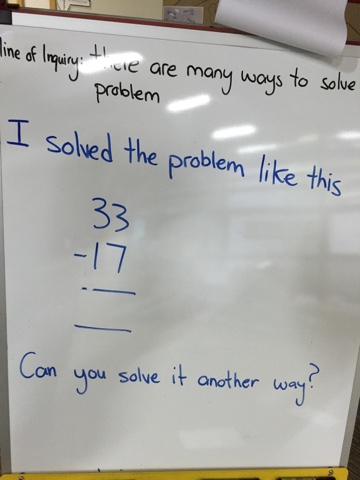
Many of my students are drilled in the use of algorithms to solve problems. I often find myself battling to try and get them to think about solving problems in different ways.

With that in mind I thought about how I could best challenge them. 

We looked at the line of inquiry: there are many ways to solve problems. 

Cheekily, I then gave them this scenario...


Instantly, there were moans and sighs.... great!

Some students couldn't resist, but when pressed to solve it another way... the thinking began!

My biggest opponents (I've had many debates with my G2 students) really struggled with solving this problem without using an algorithm. They even made 'mistakes' which they were very proud of during our reflection time. 

I really felt I got my students to think today. I could feel their pain! I  course had a smile on my 
face :)

At the end,  I asked them who is curious to find out about how to solve problems like this without having to use materials... hands flew up!

Not all my maths lessons end like this. It is important to celebrate your successes!


Thursday, 5 November 2015

Maths Reflection Wall

A great place for us to reflect on things we discovered during our maths lessons.